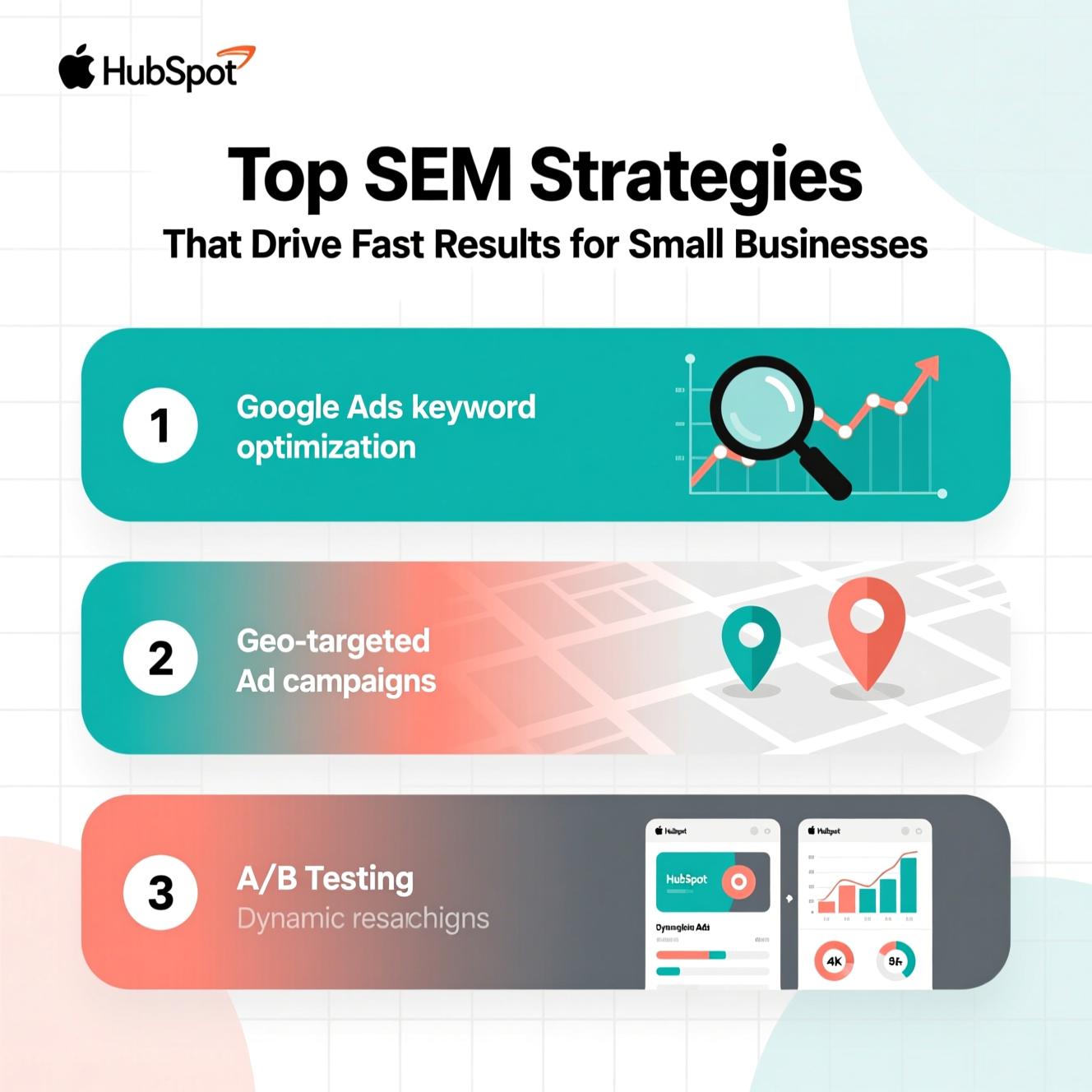
Small businesses need measurable wins fast. Search Engine Marketing (SEM) lets you generate targeted traffic, leads, and sales quickly when you apply the right tactics. This guide gives practical, actionable SEM strategies — from keyword selection to bidding, ad copy, landing pages, and measurement — so you can start seeing results within days, not months.
Why SEM is the fastest way to get targeted traffic
Search Engine Marketing (SEM) — paid search ads on platforms like Google Ads and Microsoft Advertising — puts your offer directly in front of people who are actively searching for what you sell. Unlike organic channels that take time to rank, SEM generates traffic immediately, and you control targeting, messaging, and budget. For small businesses with limited time and resources, SEM is a pragmatic way to capture demand now while you build organic channels for the future.
1. Start with a laser-focused campaign structure
A rushed SEM account that lumps many products or services together wastes budget. Start by organizing your account into tightly themed campaigns and ad groups. Each ad group should target a single product/service or a clear buyer intent stage. This structure improves quality score, ad relevance, and conversions.
- Campaigns by product line, geography, or marketing objective (e.g., Sales vs Leads).
- Ad groups for specific services, SKUs, or intent (e.g., “emergency plumbing” vs “regular plumbing”).
- Keywords in each ad group that are closely related to the ad copy and landing page content.
2. Pick high-intent keywords and use match types wisely
Not all keywords are equal. Prioritize high-intent, commercial keywords (the ones indicating purchase intent). Use keyword research tools to find the terms your customers type when they’re ready to buy.
Match type strategy:
- Exact Match for highest relevance and conversion control.
- Phrase Match to capture relevant variations with controlled reach.
- Broad Match Modifier / Smart Bidding only if you have strong conversion tracking and negative keywords in place.
Start narrow — exact and phrase — then expand with broad match only once you’re capturing conversions and you’ve added negative keywords to remove irrelevant traffic.
3. Write ad copy that converts: intention + benefit + CTA
When someone searches, your ad must quickly communicate that you solve their problem. Use headlines and descriptions to match search intent, highlight benefits, and include a clear call-to-action (CTA).
- Headline 1: Include the primary keyword or intent (e.g., “Emergency Plumber Near Me”).
- Headline 2: Add a differentiator (e.g., “24/7, Local Technicians”).
- Description: Use benefits and urgency (e.g., “Book Now — Same-Day Service. Free Estimates.”).
Use ad extensions (sitelinks, callouts, structured snippets, call extensions) to increase real estate and credibility. Extensions improve CTR and support Quality Score.
4. Landing pages that match ads and remove friction
Traffic is only valuable if it converts. Design landing pages that directly reflect the ad’s promise, remove distractions, and make the conversion action simple.
- Ad-message match: The headline and offer on the page should match the ad copy.
- Single conversion goal: One form or one phone CTA per landing page.
- Speed & mobile: Fast loading time and mobile-first layout are essential.
- Trust signals: Reviews, badges, and clear pricing help reduce friction.
Test different CTAs, form lengths, and visual layouts — small changes often have big conversion impacts.
5. Smart bidding & budget allocation
Small budgets require smart allocation. Start with conservative manual bidding for high-intent keywords or use automated bidding (Target CPA or Maximize Conversions) once you have consistent conversion data (typically 15–50 conversions per month per campaign as a rule of thumb).
Allocate budget where you get the best ROI:
- Pause underperforming keywords quickly.
- Increase bids on keywords with high conversion rates and acceptable cost-per-acquisition (CPA).
- Use dayparting and geo bid adjustments to favor times or locations that convert better.
6. Use audience signals to reduce waste
Audience targeting reduces wasted clicks. Add remarketing lists, in-market audiences, and custom intent audiences to your search campaigns to prioritize users most likely to convert.
- Remarketing: Bid higher for users who previously visited product pages.
- Customer Match: Upload lists (emails) to target past customers or high-value prospects.
- In-market & Custom Intent: Capture users actively researching your category.
7. Convert with extensions: calls, lead forms and price snippets
Extensions increase engagement without extra clicks. For local businesses, call extensions and location extensions are powerful. Lead form extensions reduce friction by allowing users to submit contact info directly from the SERP.
- Use call extensions with call reporting enabled to track phone conversions.
- Use price and structured snippet extensions to show offers at glance.
- Try lead forms for mobile-heavy campaigns to capture leads on the spot.
8. Measure what matters: track conversions and ROI
Without accurate tracking, SEM is guesswork. Ensure Google Ads and Analytics (or your analytics tool) are correctly linked and that conversions are tracked for the actions you care about: form submissions, phone calls, purchases, chat conversations.
- Set up Google Tag Manager for easier tag management.
- Track micro-conversions (e.g., newsletter signups, quote requests) as indicators of funnel health.
- Calculate true ROI by including average order value, lifetime value (LTV), and margins.
9. Use rapid testing and iterative optimization
SEM is a continuous testing discipline. Run ad copy A/B tests, landing page variants, and keyword experiments. Make small iterative changes and measure impact, so you keep improving without risking budget through big, untested changes.
- Test one variable at a time (headline, CTA, offer).
- Run tests long enough to reach statistical confidence — or set a minimum conversion threshold before deciding.
- Document wins and scale what works across similar campaigns.
10. Leverage local and seasonal tactics
Local businesses should use geotargeted campaigns, local ad extensions, and localized ad copy. Seasonal promotions and limited-time offers create urgency and lift conversion rates — schedule promotions ahead and adjust bids for peak periods.
- Use local ad copy (“Near you”, “Same-day service in [City]”).
- Bid higher in zip codes or cities with the best historical performance.
- Prepare seasonal ad creatives and landing pages for holidays or industry-specific peaks.
Quick checklist to launch a fast-performing SEM campaign
- 🔲 Create focused campaign / ad group structure
- 🔲 Choose high-intent exact/phrase match keywords
- 🔲 Write matched ad copy + use extensions
- 🔲 Build single-goal landing pages (mobile-first)
- 🔲 Set up conversion tracking & analytics
- 🔲 Start bids manually or with conservative automated rules
- 🔲 Add negative keywords and audience signals
- 🔲 Test ads & landing pages and iterate weekly
How to prioritize if your budget is small
If budget is limited, follow this prioritized approach:
- Focus on 3–5 high-intent keywords with strong conversion potential.
- Use exact match to conserve budget and maximize relevance.
- Allocate most budget to campaigns targeting high-value conversions (phone calls, purchases).
- Optimize landing pages before scaling bids — better conversion rates mean more leverage from the same budget.
Common SEM mistakes to avoid
- Running broad match campaigns without negatives or conversion data.
- Sending paid traffic to generic homepages instead of focused landing pages.
- Ignoring mobile experience and phone-call tracking for local businesses.
- Not measuring offline or assisted conversions (leads that close over the phone or in-store).
Final thoughts: SEM + organic = long-term growth
SEM gives fast, controllable results that small businesses can use to accelerate revenue while they build organic channels (SEO). Use the data from SEM — high-performing keywords, ad creatives, and landing page ideas — to inform your organic strategy. Over time, a combined paid + organic approach lowers acquisition costs and scales business growth.
Ready to get started? Use the checklist above, set up one focused campaign, and optimize weekly. If you want a quick campaign audit, paste your campaign details in the comments or contact us for a free 30-minute review.
Frequently Asked Questions
Q: How quickly can I expect results from SEM?
A: You can see traffic the same day your campaign goes live, and measurable leads in days if conversion tracking and landing pages are ready. Expect optimization to take a few weeks to reach consistent ROI.
Q: What budget do I need to start?
A: Small businesses can start with $300–$1,000/month focused on a handful of high-intent keywords. The exact budget depends on your industry CPCs and target CPA.
Q: Should I use Google Ads or Microsoft Advertising?
A: Start with Google Ads for broader reach, but test Microsoft Advertising (Bing) if your audience skews older or B2B — it often has lower CPCs and less competition.